Criteria | ICP 1 â Funded US/Can SaaS | ICP 2 â High-velocity inside-sales floor |
|---|---|---|
Name | "FundedScaleup SaaS" | "Velocity Floor" (fintech/martech) |
Company Size | 500â10,000 employees; 10+ AEs | 200â5,000 employees; 30+ SDR/AE floor |
Location | US & Canada | US & Canada |
Funding Raised | Series A/B, recently raised ($15Mâ$60M) | Series B/C, well-funded |
Industry Domain | B2B SaaS / EdTech | Fintech / Martech / high-velocity SaaS |
Stage of company | Early scaling / growth | Scaling |
Organization Structure | Flat, fast-growing: VP Sales â managers â AEs/SDRs | Large, layered inside-sales pods; heavy SDRâAE pipeline |
Decision Maker | VP Sales / CRO (economic buyer); Enablement (champion) | VP Sales / Head of Sales Dev; Enablement |
Decision Blocker | AE adoption resistance (the gatekeeper); Finance on budget | SDR/AE adoption; RevOps tooling overlap |
Frequency of use case | Daily | Many times daily (very high call volume) |
Products used in workplace | Salesforce/HubSpot, Zoom/Meet, Outreach/Salesloft, Slack, ZoomInfo | Salesforce, Outreach/Salesloft (heavy), Aircall, often Gong already, Slack |
Organizational Goals | Hit aggressive post-funding targets; ramp reps fast; predictable forecast | Maximize pipeline velocity; ramp a high-turnover floor; lift conversion |
Preferred Outreach Channels | LinkedIn, email ABM, sales communities, peer referral | LinkedIn, sales communities, peer/rep referral, events |
Conversion Time | ~30â60 days | ~30â45 days |
GMV (â ACV) | ~$14K / âš13.3L | ~$25K+ (higher seat count) |
Growth of company | High (post-funding, 50â100%+ YoY) | High |
Motivation | Scale revenue without scaling cost; cut ramp time & rep churn | Ramp high-turnover reps fast; squeeze more from every call |
Organization Influence | VP high; AE collective adoption is decisive | SDR/AE adoption decisive (turnover means tools must self-justify fast) |
Tools Utilized in workplace | CRM + dialer + engagement + comms | CRM + engagement + dialer + CI incumbent (displacement) |
Decision Time | Moderate (~1â2 months) | Moderateâfast |
Note: not exhaustive â add/remove per context.
Scored on the four criteria that decide fit for a rep-first product. Adoption Rate is the make-or-break one â it's the whole thesis.
Criteria | Adoption Rate | Appetite to Pay | Frequency of Use Case | Distribution Potential |
|---|---|---|---|---|
ICP 1 â Funded US/Can SaaS | High | High | High | High |
ICP 2 â High-velocity inside-sales floor | High | High | High | ModerateâHigh |
ICP 3 â US/Can EdTech | Moderate | Moderate | High | Moderate |
ICP 4 â India / APAC SaaS | High | Low | High | High |
ICP 5 â BFSI / Healthcare enterprise | Low | High | Moderate | Low |
From the framework, focus on ICP 1 and ICP 2. Both score High across the board â and critically, High on Adoption Rate, the single criterion that decides whether this product survives the month-3 cliff. Their reps are autonomous, coaching-hungry, and on calls constantly, and the accounts are funded enough to pay. When we flesh out onboarding and activation strategy, we build for ICP 1 and ICP 2 first.
Two deliberate calls worth flagging in the portfolio:
JTBD And Validation
Step 1: User Goals And JTBD
For the AI Sales Coaching Tool, the primary user is the Account Executive / Sales Rep.
The user does not only want âAI call feedback.â That is the surface-level goal.
The deeper JTBD is:
Help me improve my sales conversations, win more deals, and save time on CRM work without feeling watched or judged by my manager.
Core JTBD
When I finish a sales call, I want private, useful feedback and automated CRM support, so I can improve my selling, follow up faster, and increase my chances of closing deals.
Functional Goal
Improve sales performance, identify call mistakes, follow up better, and save admin time.
Emotional Goal
Feel supported, not monitored.
Business Goal
Increase rep productivity, reduce ramp time, improve win rates, and improve sales-team adoption.
Step 2: Validate User Goals
To validate the JTBD, I used conversations and observations from a business/growth event. Since I did not yet have access to a live product or real users, I treated these attendees as validation personas across buyer, product, growth, and GTM perspectives.
Validation Persona | Role | Why This Person Is Useful For Validation | What They Help Validate |
|---|---|---|---|
Keton Pathki | CMO and Head of Growth | Represents a senior growth leader who cares about revenue, acquisition, and team productivity. | Whether the product message is strong enough, whether ârep-first AI coachingâ is differentiated, and whether adoption can support growth. |
Revanth Chilagani | CEO | Represents the economic buyer who would care about ROI, productivity, and business impact. | Whether the product solves a business-critical problem worth paying for. |
Chakri Vinjamoori | Strategic Partnerships / Client Development | Represents a client-facing sales/business development persona. | Whether sales teams actually struggle with follow-ups, coaching consistency, and client conversation quality. |
Harsha M | Growth Strategist | Represents a GTM and acquisition perspective. | Whether the positioning, onboarding promise, and activation story are compelling enough to attract users. |
Vethavarshini Kavya Allam | Product | Represents the product/onboarding lens. | Whether the onboarding flow reduces friction and gets users to the AHA moment quickly. |
Apoorv Vyas | Founder | Represents an early-stage decision maker who cares about lean teams and fast outcomes. | Whether founders would see value in faster ramp, better calls, and reduced manual coaching. |
Anirudh Mantha | Sr. SEO | Represents a discoverability/content perspective. | Whether users might search for this problem through keywords like sales coaching, call feedback, CRM automation, or sales productivity. |
Supriya Rao Dasari / Sai Teja Konda / others | Event participants | General audience validation. | Helped observe whether the problem statement was understandable beyond only sales leaders. |
Validation Insights From Event Personas
JTBD Assumption | Validation Signal | What It Means |
|---|---|---|
Sales reps want to improve performance. | Growth, CEO, and client-development personas understood the need for better sales conversations. | The functional job is valid: better calls can lead to better business outcomes. |
Reps dislike feeling monitored. | Product and growth personas highlighted that adoption depends on trust and positioning. | The emotional job is critical. The tool must feel like a private coach, not a managerâs scorecard. |
CRM admin time is a real pain. | Client-development and GTM personas related to the burden of follow-ups and manual updates. | CRM auto-fill can become an early activation hook. |
Buyers care about measurable ROI. | CEO/growth personas focused on productivity, ramp time, and revenue impact. | Buyer messaging should focus on faster ramp, better win rates, and team productivity. |
Onboarding must show value quickly. | Product/growth personas reinforced that users need a fast first-win experience. | The first feedback loop should happen within 7 days. |
Product-led adoption matters. | Multiple personas pointed toward adoption as the main risk. | The product should activate reps first, then introduce manager dashboards later. |
Validated JTBD Statement
After speaking with and observing these event personas, the JTBD becomes clearer:
Sales reps do not just need another call analytics tool. They need a private coaching system that helps them improve after real sales calls, saves time on CRM work, and gives them control over what gets shared with managers.
Final Validation Conclusion
The event helped validate that the product should not lead with manager visibility or dashboards. The strongest onboarding path is:
This supports the core JTBD and directly connects to the activation metric:
AE completes their first private feedback loop within 7 days.
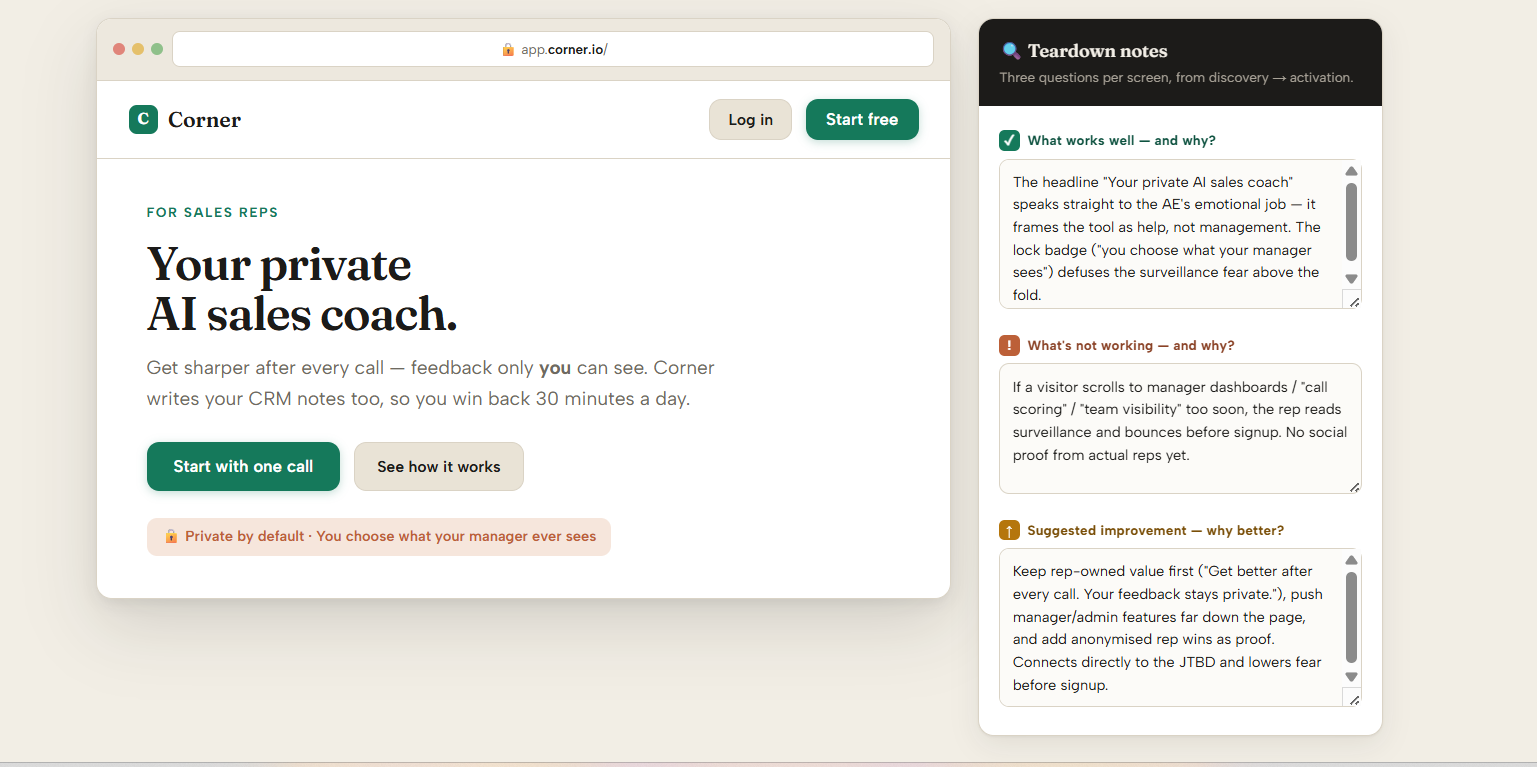
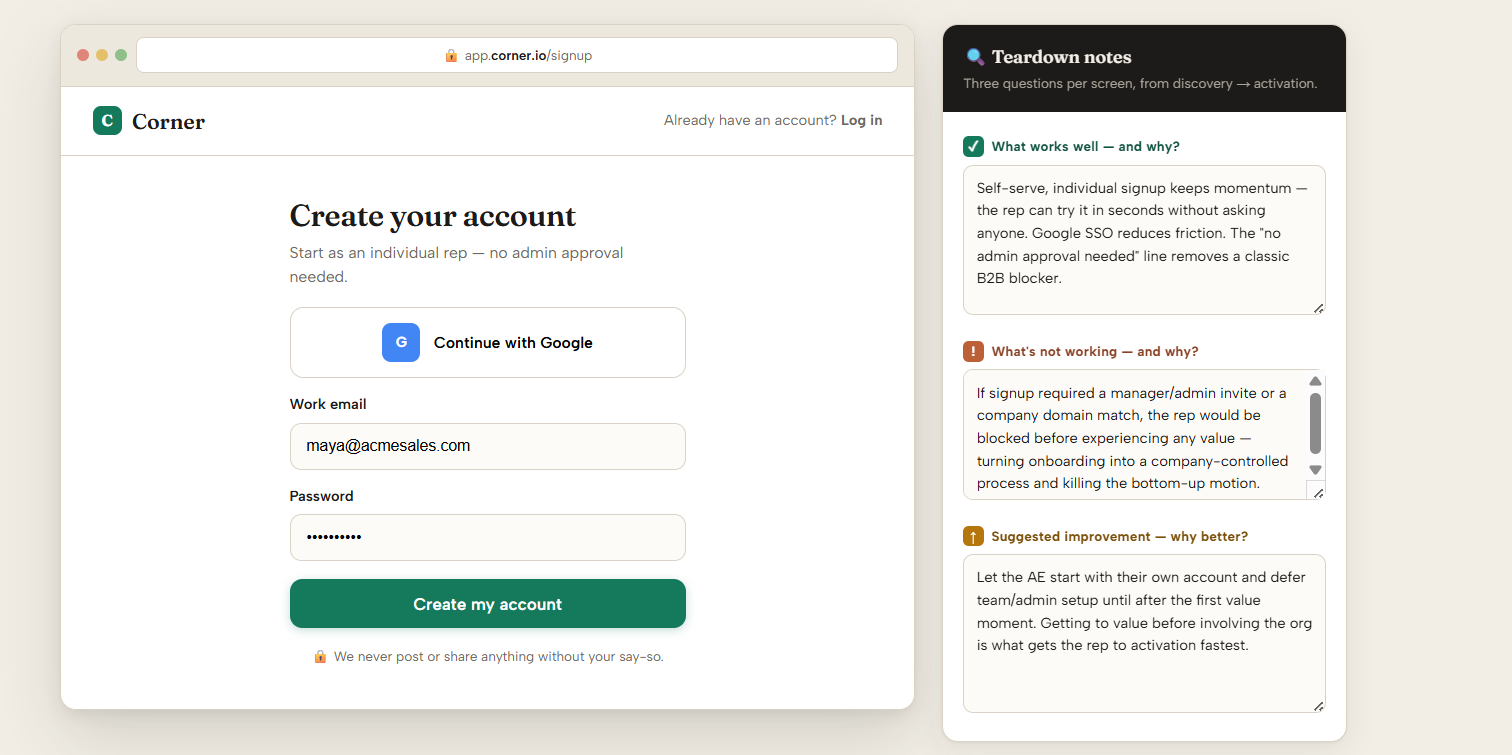
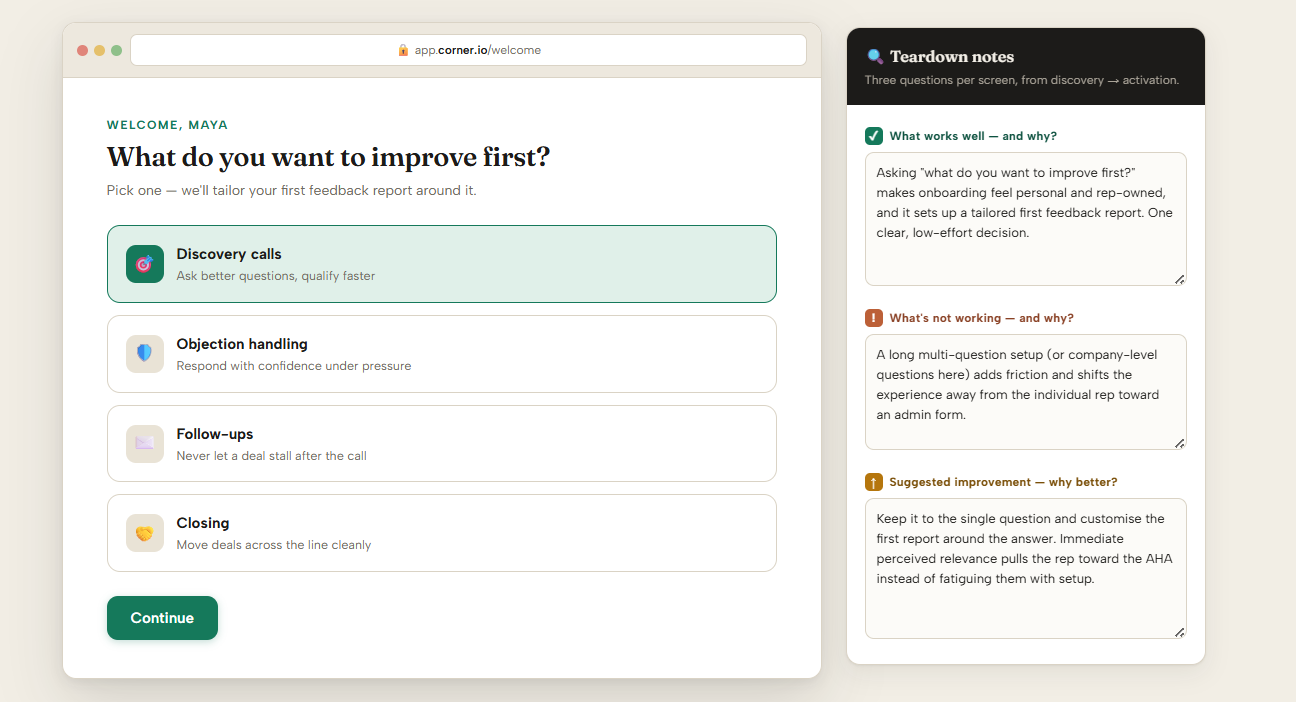
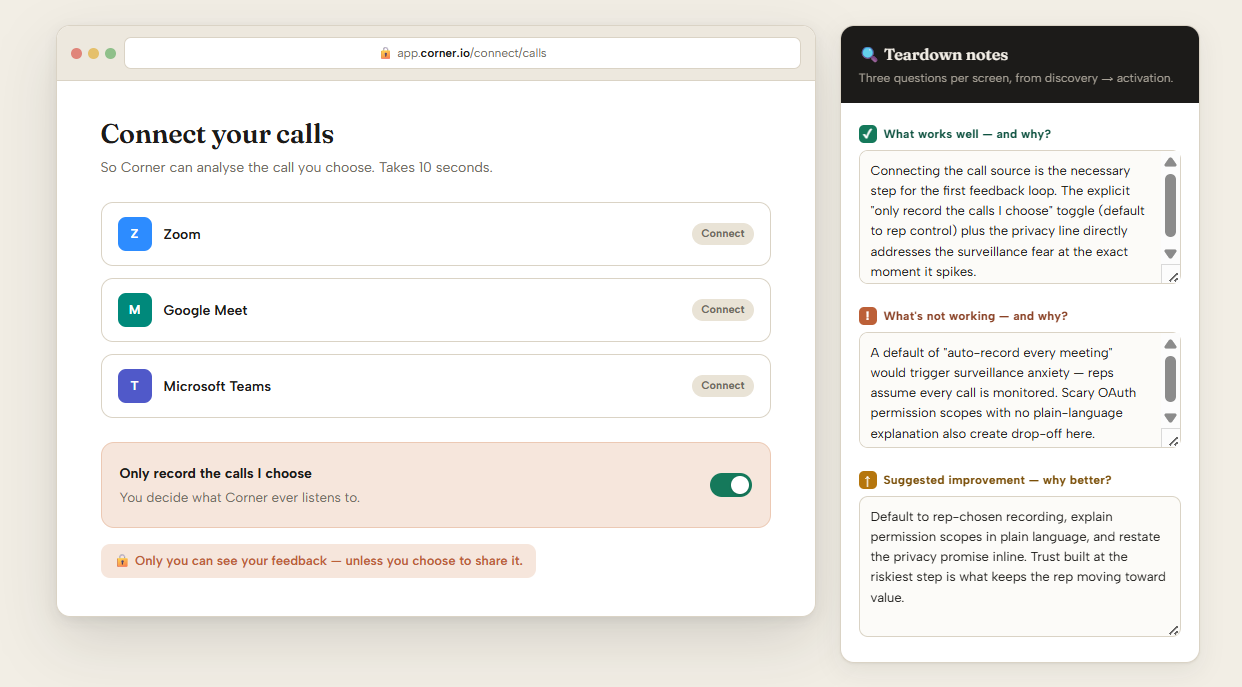
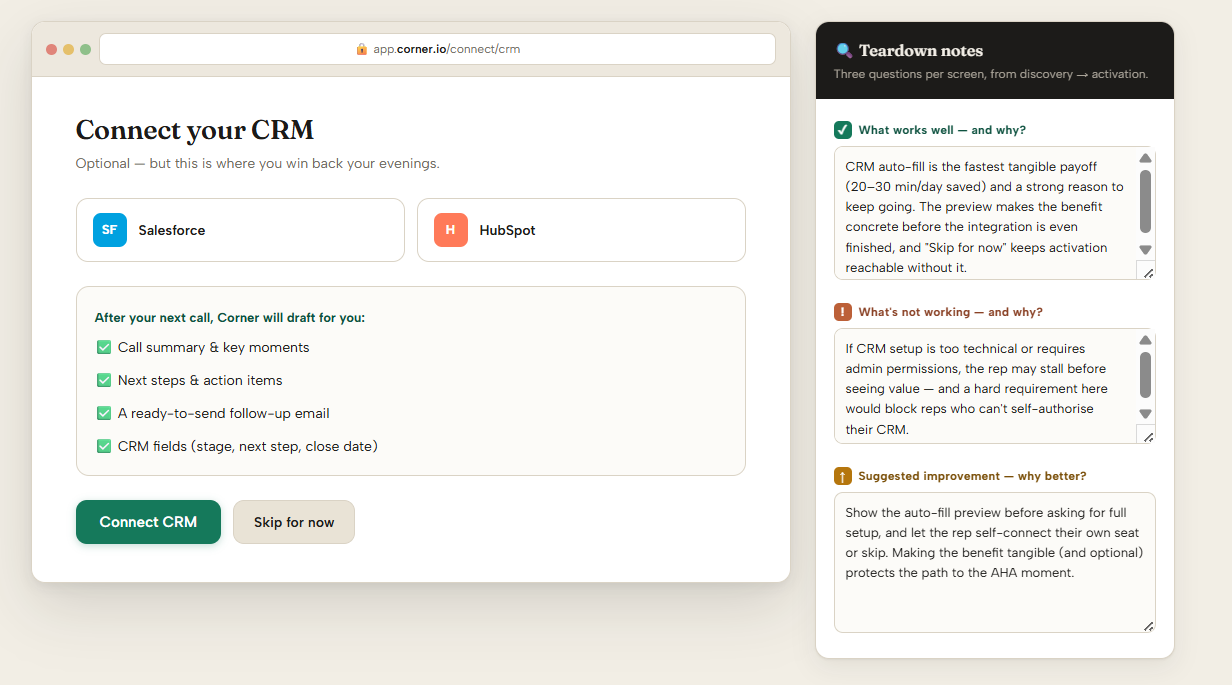
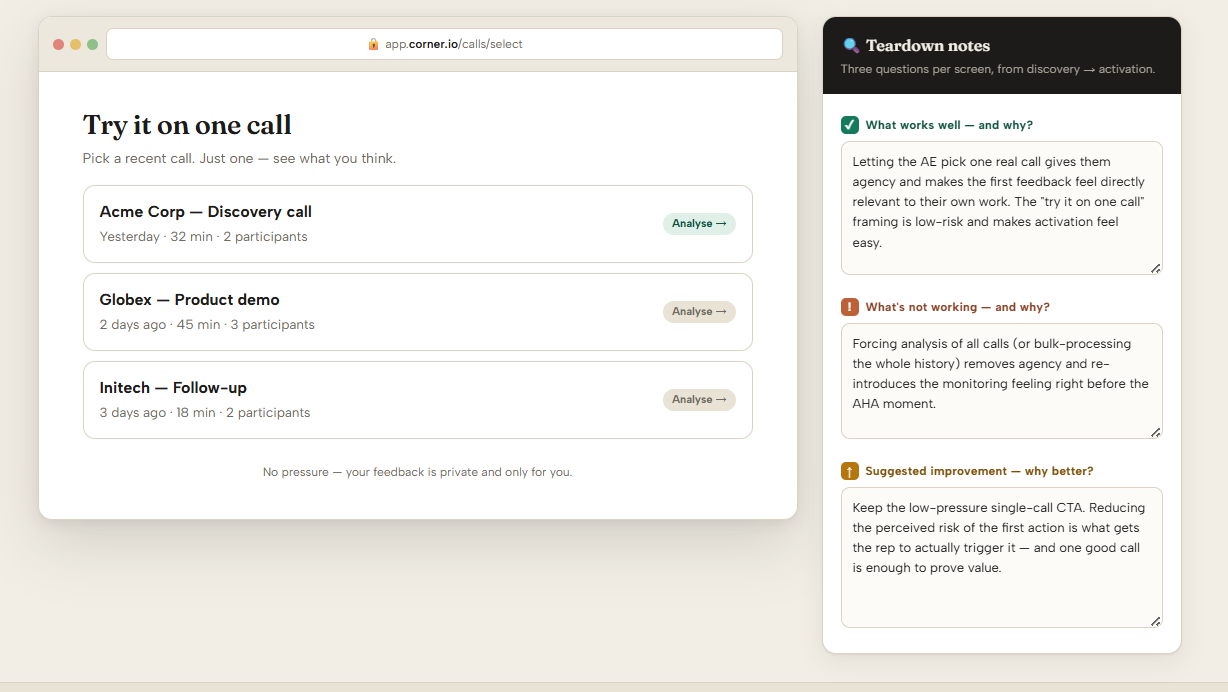
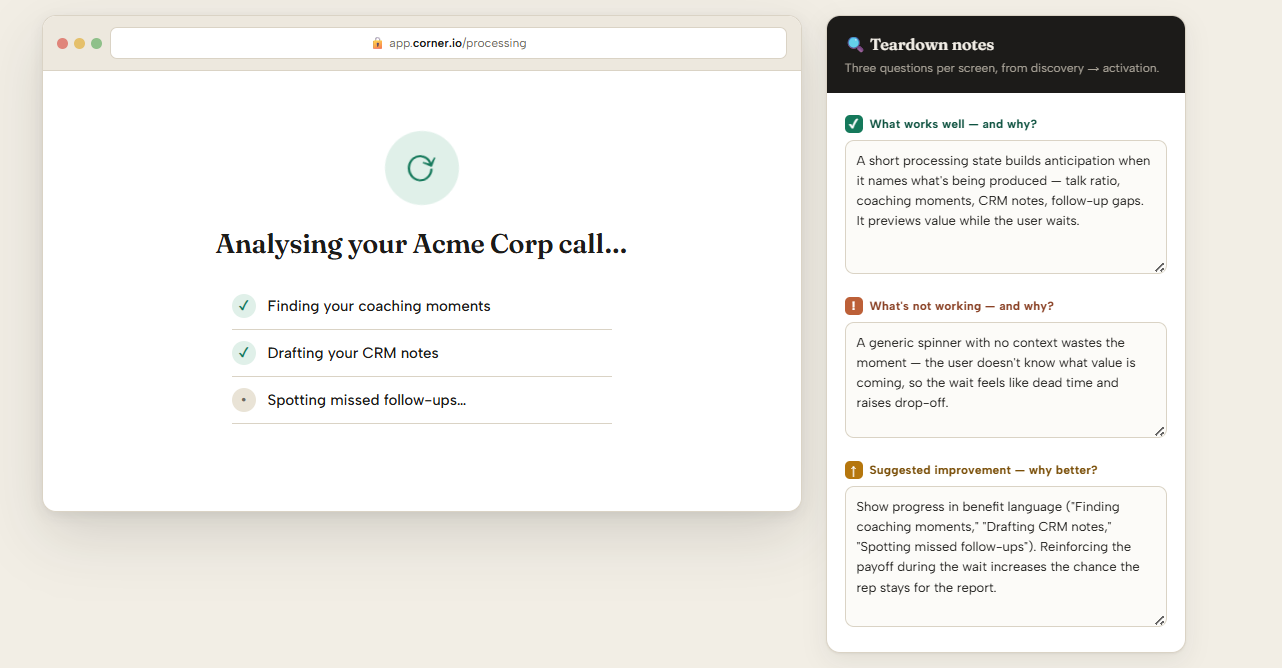
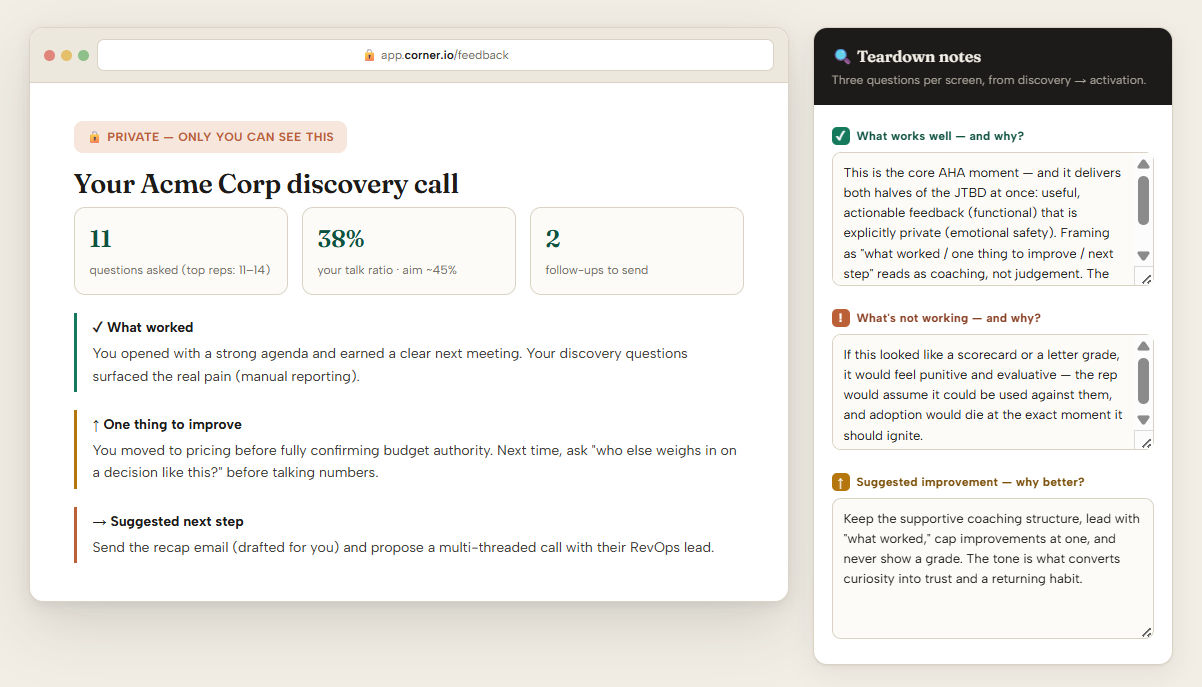
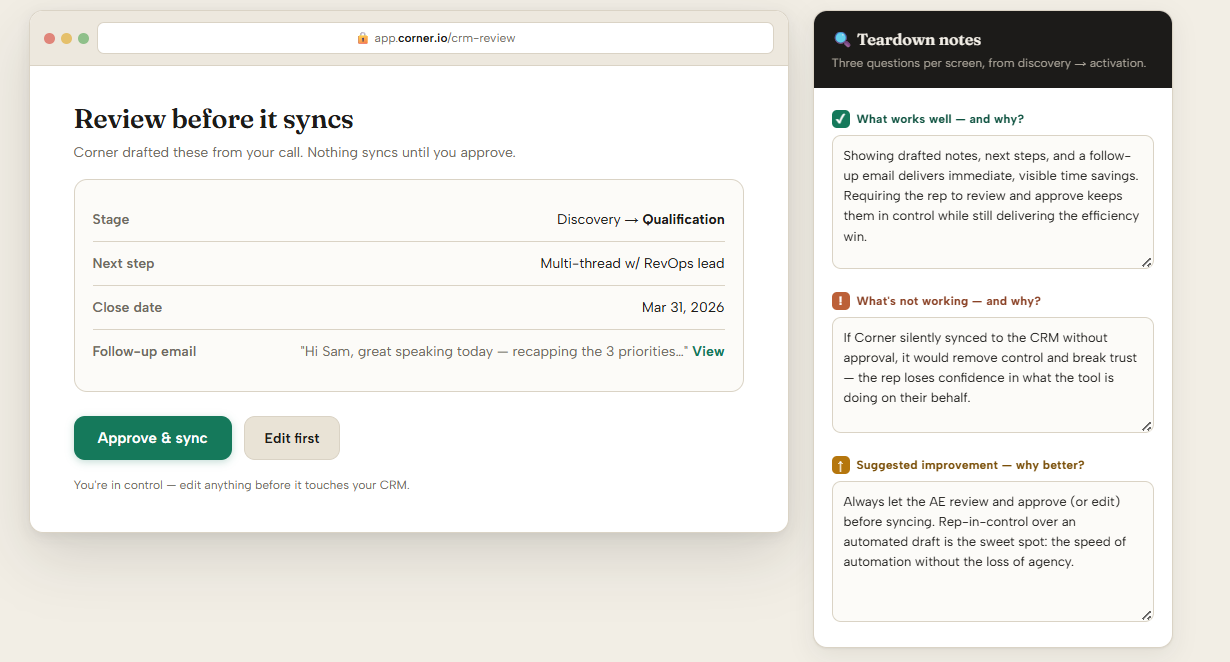
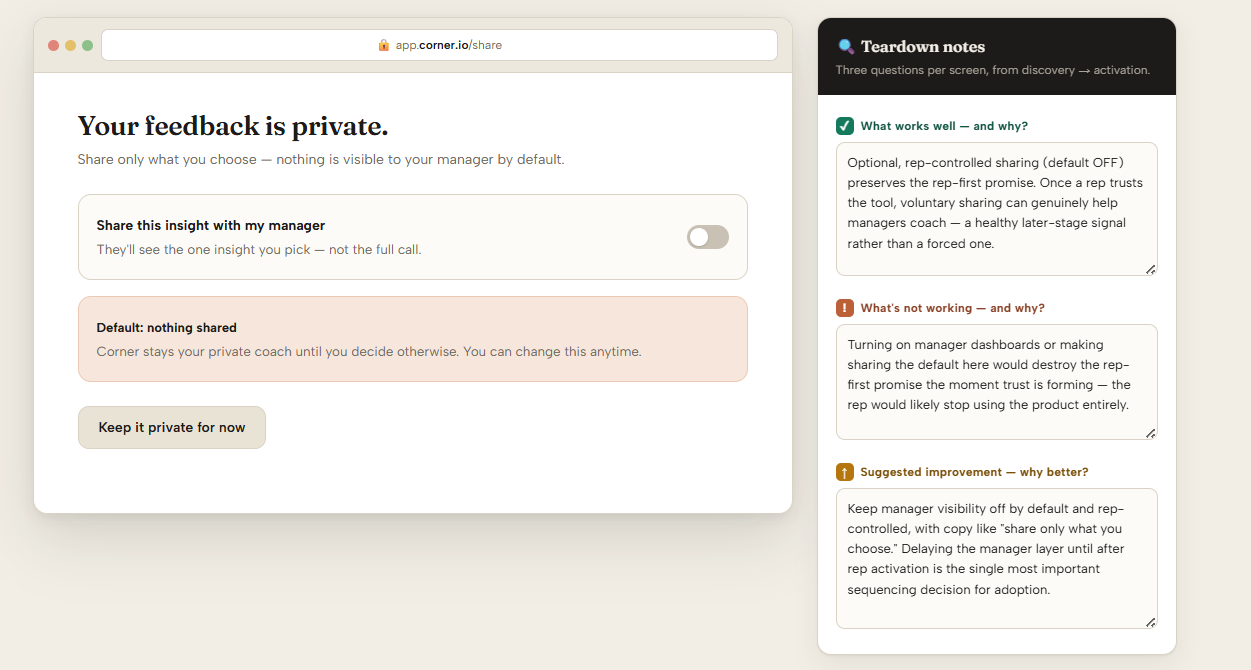
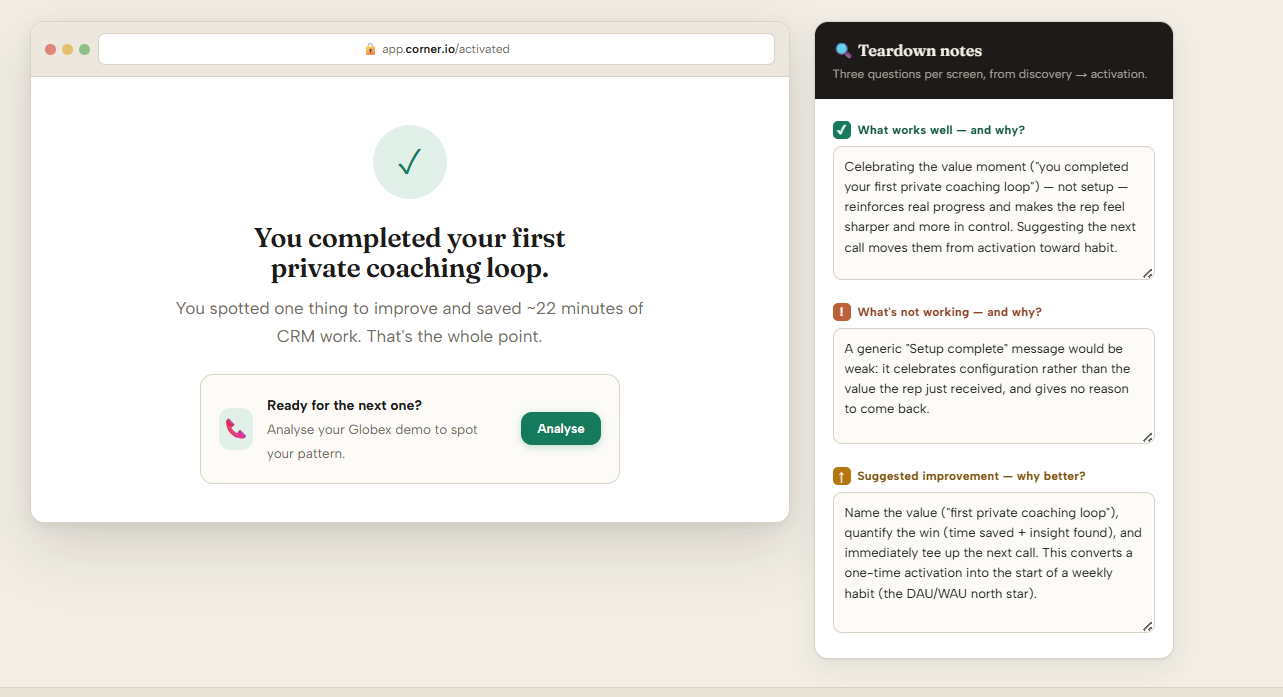
Onboarding Teardown Goal
The goal of onboarding is to get the Account Executive closer to the core JTBD:
Help me improve my sales calls, win more deals, and save CRM admin time without feeling watched, judged, or exposed to my manager.
The activation moment is:
AE completes their first private feedback loop on a real sales call within 7 days.

Screens To Include In The Teardown
Main Teardown Insight
The biggest onboarding problem for this product is not setup complexity. It is trust.
Most sales coaching tools fail because they show manager value before the rep gets personal value. That makes the AE feel watched. For this product, onboarding should reverse the sequence:
Portfolio Conclusion
A good onboarding flow for this AI Sales Coaching Tool should not rush users into dashboards, admin setup, or manager visibility. It should first create a private win for the Account Executive. Once the rep sees that the product helps them improve and saves time without exposing them, they are more likely to return, build a habit, and eventually support team-wide adoption.
Parameters To Track Your Activation Metrics
For the AI Sales Coaching Tool, activation should be tracked from the Account Executiveâs point of view because AE adoption is the biggest driver of retention.
Primary Activation Metric
Account Executive completes their first private feedback loop on a real sales call within 7 days of signup.
This means the AE has connected a call source, selected or recorded a call, received private AI feedback, reviewed the feedback, and understood at least one improvement area. This is the core âAHAâ moment because the user experiences both functional value and emotional safety.
Metric | What To Track | Why It Matters |
|---|---|---|
D1 Retention | % of AEs who return the day after signup | Shows whether the first experience was clear and useful enough to bring them back. |
D7 Retention | % of AEs still active after 7 days | Confirms whether users reached the first feedback loop within the activation window. |
D30 Retention | % of AEs still active after 30 days | Shows whether activation is turning into habit and long-term adoption. |
DAU / MAU | Daily active AEs divided by monthly active AEs | Measures product stickiness. For this product, frequent usage is important because reps should review calls regularly. |
AE DAU / WAU | Daily active AEs divided by weekly active AEs | Better than DAU/MAU for early-stage tracking because sales calls happen weekly, not always daily. |
First Feedback Completion Rate | % of AEs who review AI feedback on at least one real call | This is the key activation event. If this is low, onboarding is failing. |
Time To First Feedback | Average time between signup and first reviewed feedback report | Shorter time means users reach value faster. Target: within 7 days. |

CRM Connection Rate | % of AEs who connect CRM within 24 hours | CRM auto-fill gives fast practical value by saving admin time. |
First CRM Auto-Fill Used | % of AEs who approve or use one auto-filled CRM update | Shows that users are experiencing the time-saving benefit, not just setting up integrations. |
3+ Calls Reviewed In 14 Days | % of AEs who review feedback on at least 3 calls within 14 days | Separates one-time trial from early habit formation. |
Subscription Rate Vs Retention | Compare paid conversion with D30/D60 retention | Helps check whether users are only buying because of manager pressure or genuinely adopting. |
Average TAT | Average turnaround time from call completed to feedback delivered | Feedback must arrive quickly while the call is still fresh. |
User Cohorts | Compare activation by persona, company size, source, and use case | Helps identify which ICPs activate best. |
Acquisition Source | Track activation by LinkedIn, referral, outbound, partner, community, etc. | A channel is only valuable if it brings users who activate and retain. |
Product Reviews / AE NPS | Collect feedback from reps after first feedback loop | Validates whether the product feels like a private coach or a surveillance tool. |
Manager Share Rate | % of AEs who voluntarily share insights with manager | Useful later-stage signal. Should be optional, not forced. |
Churn Risk Signal | Accounts where AE DAU/WAU drops below 0.3 by month 2 | Early warning that adoption is collapsing before renewal risk appears. |
Activation Funnel
Stage | User Action | Time Window | Success Signal |
|---|---|---|---|
Signup | AE creates account | Day 0 | Signup completed |
Setup | AE connects calendar/call tool | Day 1 | Call source connected |
Practical Value | AE connects CRM and sees auto-fill preview | Within 24 hours | CRM value understood |
AHA Moment | AE reviews first private AI feedback report | Within 7 days | Activation achieved |
Habit Formation | AE reviews 3+ calls | Within 14 days | Early habit forming |
Stickiness | AE keeps using product weekly | Within 30 days | Strong D30 retention |
Expansion Readiness | AE voluntarily shares coaching insight | After activation | Manager layer can be introduced |
North Star Metric
AE DAU/WAU per account
This is the best north-star metric because the product only succeeds if reps keep coming back. Manager dashboards, deal-risk alerts, and enablement insights all depend on consistent AE usage.
Final Activation Hypothesis
If an Account Executive completes their first private feedback loop within 7 days and reviews feedback on 3 or more calls within 14 days, they are more likely to become a retained user and support team-wide adoption.
Brand focused courses
Great brands aren't built on clicks. They're built on trust. Craft narratives that resonate, campaigns that stand out, and brands that last.
All courses
Master every lever of growth â from acquisition to retention, data to events. Pick a course, go deep, and apply it to your business right away.
Courses
Built by Leaders From Amazon, CRED, Zepto, Hindustan Unilever, Flipkart, paytm & more
Crack a new job or a promotion with ELEVATE
Designed for mid-senior & leadership roles across growth, product, marketing, strategy & business
Learning Resources
Browse 500+ case studies, articles & resources the learning resources that you won't find on the internet.
Patienceâyouâre about to be impressed.